Catacombs of Paris: history, visit, tickets, legends, and tips
The Catacombs of Paris are one of the largest and oldest ossuaries in Paris, and you may visit a small section of it as a part of a thrilling route packed with history, trivia, and legends. Tag along with us in order to get to know its history, how to reach it and get your tickets, and which visiting hours are available!
What are the Catacombs of Paris?
The Catacombs of Paris are a massive underground ossuary which can be visited in Paris, comprising a series of chambers and tunnels located within old stone quarries, dating back to Roman and Medieval times. It is estimated that they are home to over six million individual human remains, which would make it the largest ossuary in all of Europe.
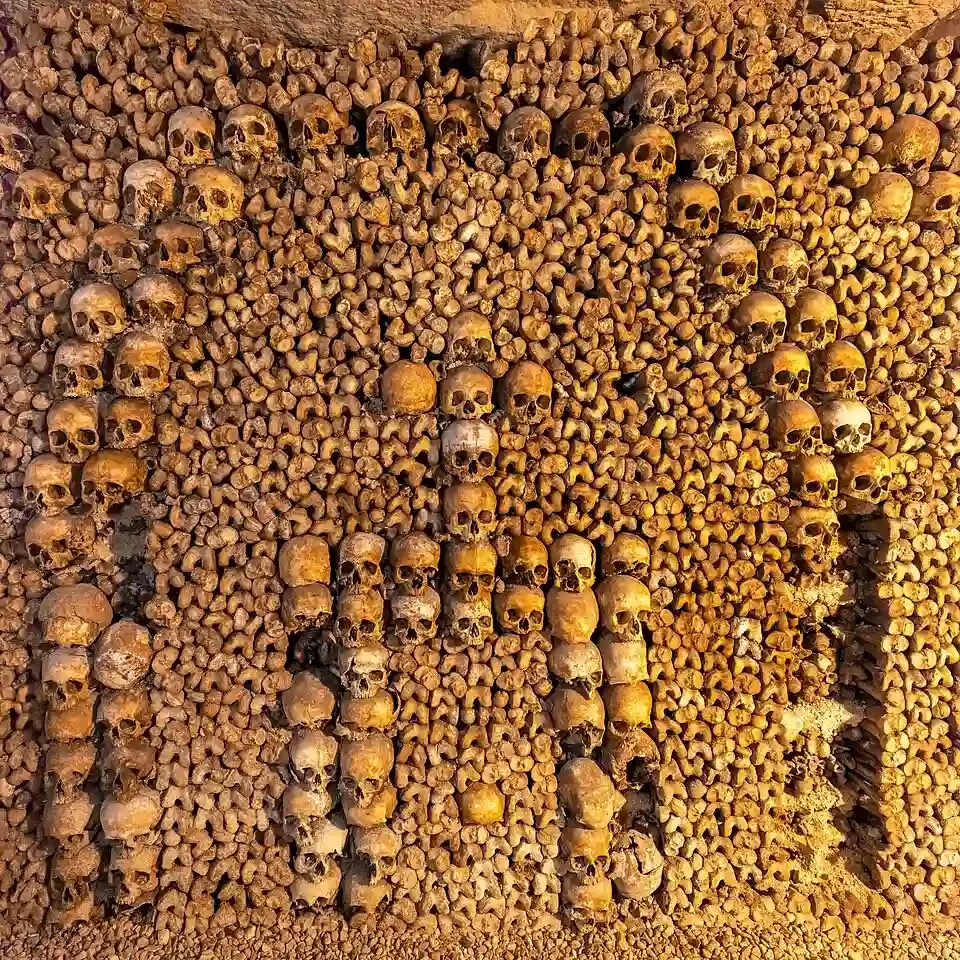
The official visit to the catacombs, which takes up a meager 0.5 % of its total extension, encompasses the old quarries in Paris’ district 14, and it leads the visitor throughout roughly one kilometer (over half a mile) of tunnels which are completely coated in bones.
History and origins: why were the catacombs built?
The Catacombs of Paris originated in the excess of stashed human remains endured by the graveyards in France’s capital city during the late 1700s. In this way, in 1785, it was decided that, while new and more modernized cemeteries were laid out in the outskirts, the ancient tunnels and underground caves would be used to stack the bones that did not fit in the churchyards.
The issue extended beyond mere space: owing to the piling of corpses and their deficient handling, a veritable health crisis had burst out in some districts in town. More particularly, the borough of Les Halles and its Graveyard of the Innocents, which had suffered several crumbling issues and had to be closed down, was one of the hot spots for this crisis. This cemetery had been Paris’ main graveyard ever since the 1100s, and it was so overcrowded that its walls and ceiling had been filled up with the bones that no longer fit in the tombs for centuries. By the time the crumbling took place, during the mid 1700s, the core of the cemetery was an enormous, two-meter (over six feet) high mound which encompassed deceased individuals from many generations. The situation was unsustainable!

Both the cemetery issue as well as the one concerning the consolidation of former quarries were under the joint oversight of the incumbent Paris Police Chief, the lieutenant general Alexandre Lenoir, as well as Charles-Axel Guillaumot, the general quarry inspector. They decided, during springtime of 1785, to move all of the “leftover” mortal remains into the city underground.
Over the following two years, several mass transfers of human remains were carried out into these former quarries, generally by means of dark, shrouded carts that roamed through Paris at night. By 1790, six million Parisians from diverse eras already rested in what would become the famous Catacombs of Paris. Just a few years later, the dead bodies of main actors in the French Revolution, such as Charlotte Corday, Madame du Barry, Jacques Danton, and Maximilien Robespierre would also be laid to rest there.
The catacombs were closed off and forgotten about for several decades until, by the early 1800s, the macabre spirit of Romanticism reopened them for private events and concerts which gathered the boldest and most curious people in Paris. In 1810, following some overhauls (conducted by Louis-Étienne Héricart de Thury, the Mine Inspection director) in order to make them walkable and visually pleasing, as well as opening up several entrances, the Catacombs of Paris opened their gates to the citizenry as a visitable mausoleum on special occasions, and always with a permit from Mine Inspection. After the 1889 and 1900 Universal Exhibitions, the visits started to be made on a daily basis and with no need of technical authorizations.

Within the tunnels, not only millions of stacked bones can be found, but also inscriptions in Latin, identity plaques for some of the deceased, small shrines, and even graffiti made by the workers who transferred the remains.
Arrête! C’est ici l’empire de la Mort ! (Stop! Here begins the Empire of Death!), says the entrance archway to the Catacombs of Paris… Do you have what it takes to pay them a visit?
Where are the Catacombs of Paris, and how can I reach them?
Next up, we will explain where the Catacombs of Paris are, and how to reach them easily and directly from several key locations in town, both from the historic center as well as from other districts with more comfortable and affordable accommodation to stay in.
The Catacombs of Paris are located in district 14, beneath Denfert-Rochereau square. More precisely, the main entrance for visitors can be found on number 1, Avenue du Colonel Henri Rol-Tanguy.
How to reach them from downtown Paris:
🚇 By metro
- Line 4 (purple): alight at Denfert-Rochereau station.
Line 6 (green): it also stops at Denfert-Rochereau.
🚆 By RER
- RER B: Denfert-Rochereau station.
🚌 By bus
- Lines 38 and 68 have both nearby stations.
How to reach them from District 18 (Montmartre Sacré-Cœur):
🚇 By metro
Line 4 (purple): hop on at Barbès–Rochechouart or Château Rouge, and alight at Denfert-Rochereau.
How to reach them from District 10 (Gare du Nord and Canal Saint-Martin):
🚆 By RER
- RER B: Denfert-Rochereau station.
How to reach them from District 10 (Gare du Nord and Canal Saint-Martin):
🚌 By bus
- Line 6 bound for Charles de Gaulle–Étoile.
Tickets, fees, and kinds of visit to the catacombs
Let us talk about how to get your tickets for the Catacombs of Paris, how much they cost, and what the guided visits to the monument are like!
-
You are to purchase your tickets online and one week in advance. Time slots are made available every day as of 10:00, and they sell out really quickly, so do not put it off!
-
There are several kinds of tickets:
-
Regular ticket: 31 € with an audio guide included.
-
Discount ticket (for youths up to 26 years old, students, and some cultural associations – documents will be required): 25 € with an audio guide included.
-
Tickets for kids aged 5-17: 12 € with no audio guide.
-
Tickets for minors under 5 years old: free entry, no charge and no booking needed.
-
Additional audio guide (if it is not included): 5 € at the box office.
-
The tickets are nominative and have an allocated time slot. They are neither refundable nor modifiable, barring the case of an exceptional closure of the monument. Make sure to double check your time slot and date before you pay!
-
The route open to the public runs for approximately 1.5 km (just under a mile) of underground tunnels which include 131 steps downstairs, and 112 upstairs. The visit typically lasts from 45 minutes to 1 hour, depending on the pace and whether an audio guide is used or not. For guided visits, the duration can be stretched to 1h 15 min or 1h 30 min.
-
With your ticket, booked online, you will be granted access to the Catacombs during your chosen time slot, following a wait of 10 to 20 minutes at most. Without prior booking, the queue waiting time can exceed two hours during peak season. If you have no prior reservation and decide to wait in the queue, it is best to arrive a while before opening time, and avoid weekends.

Tickets for the Catacombs of Paris – Fees and Documents (2025)
| Category | Fee | Required documents |
| Full fee | 31 € (audio guide included) | None (just your ticket) |
| Discount fee | 25 € (audio guide included) | A valid document featuring a picture: – Ages 5-26 or students (ID card) – Members of cultural associations (credentials) – There is a chance you might have to provide proof of residence in the EU |
| Kids’ fee (ages 5-17) | 12 € (no audio guide) | ID card or passport for the minor |
| Under 5 years old | Free | A document proving their age (passport, ID card) |
| Free entry (ex. Disabled people, unemployed, RSA, artists and journalists) | 0 € | An official certificate or badge, depending on the case. Tickets may only be purchased at the box office for the current day. |
Visiting hours for the Catacombs of Paris
The Catacombs of Paris are open to visitors from Tuesday through Sunday, from 09:45 to 20:30 (last admission at 19:30). It remains closed on Mondays and foremost bank holidays such as January 1st, May 1st, and December 25th.
Access, safety and accessibility rules
Next on, you will be offered a detailed summary about the access, safety and accessibility rules in force in the Catacombs of Paris, featuring tips for claustrophobic people:
- The official route features 130 steps downstairs and 83 upstairs, as well as narrow corridors which may prove difficult to transit for larger groups.
- The temperature indoors stands roughly at 14 °C (57 ºF), with high humidity, so you are advised to wear comfortable, closed and slip-resistant footwear, as well as wear a light coat or long sleeves, even during summertime. Avoid any pieces of clothing which may tangle up in the narrow tunnels.
- It is not allowed to carry suitcases, backpacks or large purses, food or drinks (except water), and tripods or unauthorized professional photography equipment into the catacombs.
- It is allowed to take pictures without flash for personal purposes, but it is forbidden to use drones, bright lights, or professional recording equipment without a special permit.
- The Catacombs are not accessible for people with reduced mobility owing to its staircases and narrow corridors. It is not accessible for baby strollers nor wheelchairs, either.
- The access to the galleries which are not open to the public is illegal, and it may entail fines, arrests, and penal sanctions. Visitors are to comply with the rules and signs within the route, and the management will not be liable for any accidents stemming from the breaching of the rules or from risky demeanor.
- The visit could be stressful for people with heart or respiratory conditions, or claustrophobic visitors, owing to its narrow corridors and the feeling of confinement. Should you experience claustrophobia, do consider visiting this landmark with a companion and at ease. If thinking about visiting it causes you anxiety, seek out different, more adequate activities.
- Official website featuring accessibility rules.
What to see indoors: remarkable milestones along the route
Let us summarize what to see on your visit across the Catacombs of Paris so that you do not miss out on its best spots!
- Entrance and descending staircase: You will access the catacombs through an archway engraved with the famous inscription Arrête! C’est ici l’empire de la Mort and a well at the entrance with a long staircase which runs for 130 steps. Take in the structure of the ancient tunnels and the 1700s architecture, and get ready for a one of a kind underground adventure!
- Stone corridors and historic tunnels: the route will lead you across roughly one kilometer (just under a mile) of narrow corridors carved in limestone, which are no other than the old remnants of the quarries used to build Medieval Paris. Some walls show inscriptions and marks made by the original masons.
- Ossuaries and bone walls: the main attraction here are the ossuaries, walls and mounds made up of millions of human bones, arranged in a precise, almost artistic fashion, which were transported from the cemeteries of Paris during the 1700s and the 1800s.
- Plaques and origin of the remains: throughout the route, you will find plaques displaying where these human remains come from (mostly from the Cimetière des Innocents, the Cimetière de Saint-Étienne and the Cimetière de la Madeleine).
- Themed ambiances and historic details: there are sections in which old quarrying tools are showcased, as well as explanatory banners and historic maps of Paris’ underground. The visit comes to an end with a climb of 83 steps.

Legends, myths and fun facts about the catacombs
Would you like to read some of the best legends and fun facts about the Catacombs of Paris?
- Cataphiles and urban exploring: the cataphiles are urban explorers who visit the catacombs outside official routes, roaming across tunnels and galleries which are closed to the public. They have given rise to an entire subculture featuring secret maps and exploring clubs! Remember that unauthorized access is illegal and dangerous.
- Myths, cinema, and literature: the catacombs have inspired books, films, and urban legends linked with horror stories, conspiracies, and secret societies. However, most stories about murders, dark rituals, or endless tunnels are urban myths!
- Noteworthy findings and historical fun facts: curious findings have been documented, such as graffiti made by old masons and visitors, and historical banners with information about the origins of the bones, or health regulations from bygone times.
| Myth | Reality |
|---|---|
| The catacombs hide secret rituals and mysterious societies. | There are cataphiles, but clandestine outings are illegal and there is no evidence of long-running rituals. |
| The tunnels sprawl beneath all of Paris and connect secret places. | The tunnels are sprawling, but only certain sections are safe and mapped; many areas have collapsed or are inaccessible. |
| There have been recent crimes, and dead bodies are hidden in the galleries. | The bones come from historical cemeteries; there is no evidence of crimes in the open catacombs. |
Useful tips and the best time to go
At last, here are some tips to visit the Catacombs of Paris!
- The best thing you can do in order to skip the queues is to avoid the peak season (summertime and school holidays) and weekends. The best time to see them is first thing in the morning or late in the evening.
- Wear comfortable clothes and shoes, a coat, water, and a photo camera with the flash off. You cannot carry suitcases or large purses, nor any food. Your visit will run for a bit less than an hour.
- The minimum recommended age for the visit is 10 years old, given the explicitness of the content and the narrowness of the location. Remember that, should you have any heart or respiratory conditions, or also claustrophobia, it might be better to seek out other, more lighthearted activities.
- Book your tickets online and in advance. Get there a bit earlier than the visiting time and follow the safety guidelines and signs at all times.
- You may combine your visit to the catacombs with places such as the Paris Observatory or a tour across Montparnasse.
- Family-friendly recommendation: suggested minimum age, content sensitivity.

Discover Paris like never before with our amazing Free Tours!
Explore the City of Light with expert guides and immerse yourself in its history, art, and legends. From its iconic monuments to its most bohemian and mysterious neighborhoods, we have the perfect tour for you.
Frequently Asked Questions (FAQ)
Why are there skulls and bones in the Catacombs?
The bones were transported to the catacombs during the 1700s and the 1800s in order to free space in overcrowded graveyards and improve the health conditions in downtown Paris.
How many bodies are there, approximately?
It is estimated that there are between 6 and 7 million human remains arranged in walls and mounds within the ossuary.
How deep are they, and what is their temperature?
The official visit to the catacombs lays approximately twenty meters (sixty-five feet) below the ground, with a constant temperature of 14°C (57 ºC) and very high humidity.
How long does the visit last, and how many steps are there?
The visit runs from 45 to 60 minutes, and it includes 130 steps downstairs, as well as 83 upstairs.
Is it legal to explore it beyond the tourist route? What kind of fines are there?
It is illegal to explore galleries outside the official route. The sanctions include fines, arrest, and penal sanctions.
Are they underwater? Is there any flooding risk?
Some historical sections can accumulate quite a bit of humidity, but the tourist route is not underwater, and it is completely safe.
Can I access them for free any day?
The visit to the catacombs typically requires the payment of an admission fee, nearly always. Some cultural days in Paris could feature free admission, check it in advance at the official website!
Where is the entrance, and where do I exit them?
The entrance to the catacombs is in number 1 Avenue du Colonel Henri Rol-Tanguy, whereas the exit is in 21bis, Avenue René-Coty.
Can kids go in? Are there any restrictions?
Admission is unadvised to kids under the age of 10 due to sensitive content.
Can I visit them with Paris Pass or Museum Pass?
The catacombs are not included in the Paris Pass nor the Museum Pass. The tickets must be purchased separately at the official website or the box office.